
IoT & Smart Manufacturing
Industrial IoT & Machine Monitoring Software for Manufacturers
We build the software that connects machines, sensors and devices to the cloud, from MQTT and custom hardware integration to real-time dashboards, alerts and analytics for the shop floor.
- Role-based access (RBAC)
- SSO / Keycloak
- Biometric sign-in
- Encrypted device communication
- Azure / AWS security best practices
Challenges
What's holding IoT teams back
Invisible machine downtime
Without live data, stoppages and idle time are only noticed on a walk-around or at the end of a shift.
Mixed and legacy equipment
Machines from different vendors and decades rarely share a common data interface.
High-volume, real-time data
Thousands of events per minute must be ingested, stored and shown live without lag.
Security on the shop floor
Connected devices, shared terminals and many user roles widen the attack surface.
Solutions
What we build
Machine monitoring software
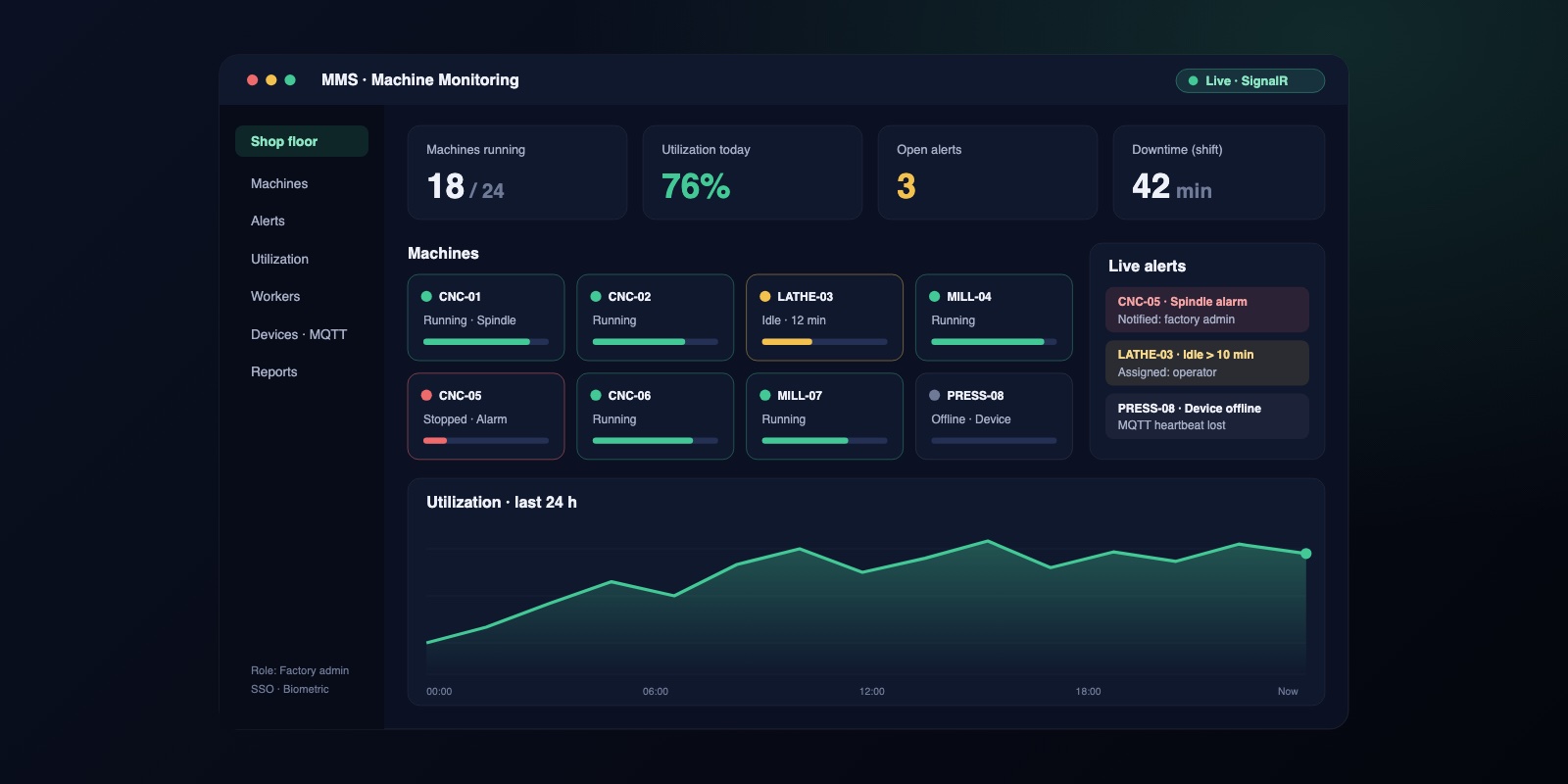
Live machine status, utilization, downtime and OEE dashboards with alerts for stopped, idle or offline machines.
Device & MQTT integration
Firmware-to-cloud integration with PCB-based devices, PLCs, sensors and gateways over MQTT and industrial protocols.
Real-time dashboards
SignalR and WebSocket dashboards for admins, factory managers and operators, on desktop, tablet and mobile.
IoT cloud platforms
Scalable ingestion, time-series storage and APIs on Azure IoT Hub or AWS IoT Core, multi-tenant from day one.
Predictive maintenance & AI
Anomaly detection and failure prediction from machine and sensor data to cut unplanned downtime.
ERP & MES integration
Sync production, job and machine data with ERP and MES systems so planning runs on real numbers.
Trusted by startups, scale-ups and global brands











Services for this industry
IoT Solutions
Connected devices, real-time dashboards, edge computing and industrial IoT.
Learn moreDevOps & Cloud
CI/CD, infrastructure as code, Kubernetes and cloud cost optimisation.
Learn moreCustom Software Development
Secure, scalable custom software, from enterprise systems to internal tools and APIs.
Learn moreAI & Machine Learning
Predictive analytics, computer vision, generative AI and ML models that turn data into decisions.
Learn morePricing & timeline
How much does machine monitoring or IoT software cost in 2027?
Typical budgets and timelines with our senior team at $25–$40 per hour, including design, development, QA and project management.
| Scope | Timeline | Typical cost |
|---|---|---|
| Machine monitoring software v1MQTT device integration, live status, downtime, alerts, dashboards | 12–18 weeks | $15,000–$25,000 |
| Custom IoT platformDevice provisioning, time-series data, dashboards, mobile app | 4–6 months | $20,000–$38,000 |
| Multi-tenant industrial platformOEE, role-based dashboards, mobile apps, ERP integration | 6–9 months | $30,000–$55,000 |
Software only: sensors, gateways and connectivity are extra. Every project is quoted individually after a free call. Get an instant estimate or ask for a fixed quote.
Ready to accelerate your roadmap?
Get a free consultation and a clear plan in 30 minutes.
FAQ
Frequently asked questions
Can't find your answer? Ask our team.
How much does machine monitoring software cost?
Machine monitoring software with device integration over MQTT, live machine status, downtime and utilisation tracking, alerts and dashboards typically costs $15,000–$25,000 for a first version. A multi-tenant platform with OEE, role-based dashboards, mobile apps, reporting and ERP integration usually costs $30,000–$55,000. Our rate is $25–$40 per hour; sensors and gateways are a separate hardware cost.
How much does it cost to build an IoT platform?
A custom IoT platform with device provisioning, secure ingestion, time-series storage, real-time dashboards, alerts and a mobile app typically costs $20,000–$38,000. Adding firmware work, over-the-air updates, multi-tenancy, analytics and predictive maintenance brings it to $38,000–$75,000 or more. Managed services such as Azure IoT Hub or AWS IoT Core keep the infrastructure share of the budget small.
How long does an industrial IoT project take?
A machine monitoring or IoT pilot on a handful of machines takes 8–12 weeks, including device integration and dashboards. A production platform across several sites takes 4–8 months in phases. We recommend piloting on one line or site first to validate data quality and alert thresholds before rolling out across the factory.
What tech stack do you use for IoT and machine monitoring?
We typically use MQTT for device messaging, Azure IoT Hub or AWS IoT Core for secure ingestion, a time-series database such as TimescaleDB or InfluxDB, a .NET or Node.js backend, SignalR or WebSockets for live dashboards, React for web and Flutter for mobile. Edge gateways buffer data when connectivity drops and translate shop-floor protocols for the cloud.
Should I use OPC UA or MQTT for industrial IoT?
Usually both, for different jobs. OPC UA is the standard for reading structured data from PLCs and modern machines on the shop floor, while MQTT is a lightweight publish/subscribe protocol ideal for moving that data to the cloud. A common architecture reads OPC UA or Modbus at an edge gateway and publishes over MQTT with TLS, optionally using the Sparkplug payload format.
Can you connect older machines that have no data interface?
Yes. Where a machine has no PLC access or data port, we integrate add-on hardware such as PCB-based monitoring devices, current sensors or vibration sensors that publish machine state over MQTT. This gives you running, idle and stopped status from equipment of any age without modifying its controls.
How do you secure IoT devices and factory data?
Each device gets its own identity and certificate, communication is encrypted with TLS, and devices may only publish to the topics they're allowed. On the platform we use role-based access, SSO, audit logs and separation between shop-floor and office networks. We design with IEC 62443 principles in mind and keep firmware updatable so vulnerabilities can be patched.
Which cloud is best for an IoT platform: Azure or AWS?
Both work well; the best choice is usually the cloud your company already uses. We have built production IoT platforms on Microsoft Azure with IoT Hub and SignalR, and also work with AWS IoT Core and Google Cloud. For sites with strict data rules, we can keep processing at the edge or on-premises and send only summaries to the cloud.
Can you build real-time dashboards for different roles in the factory?
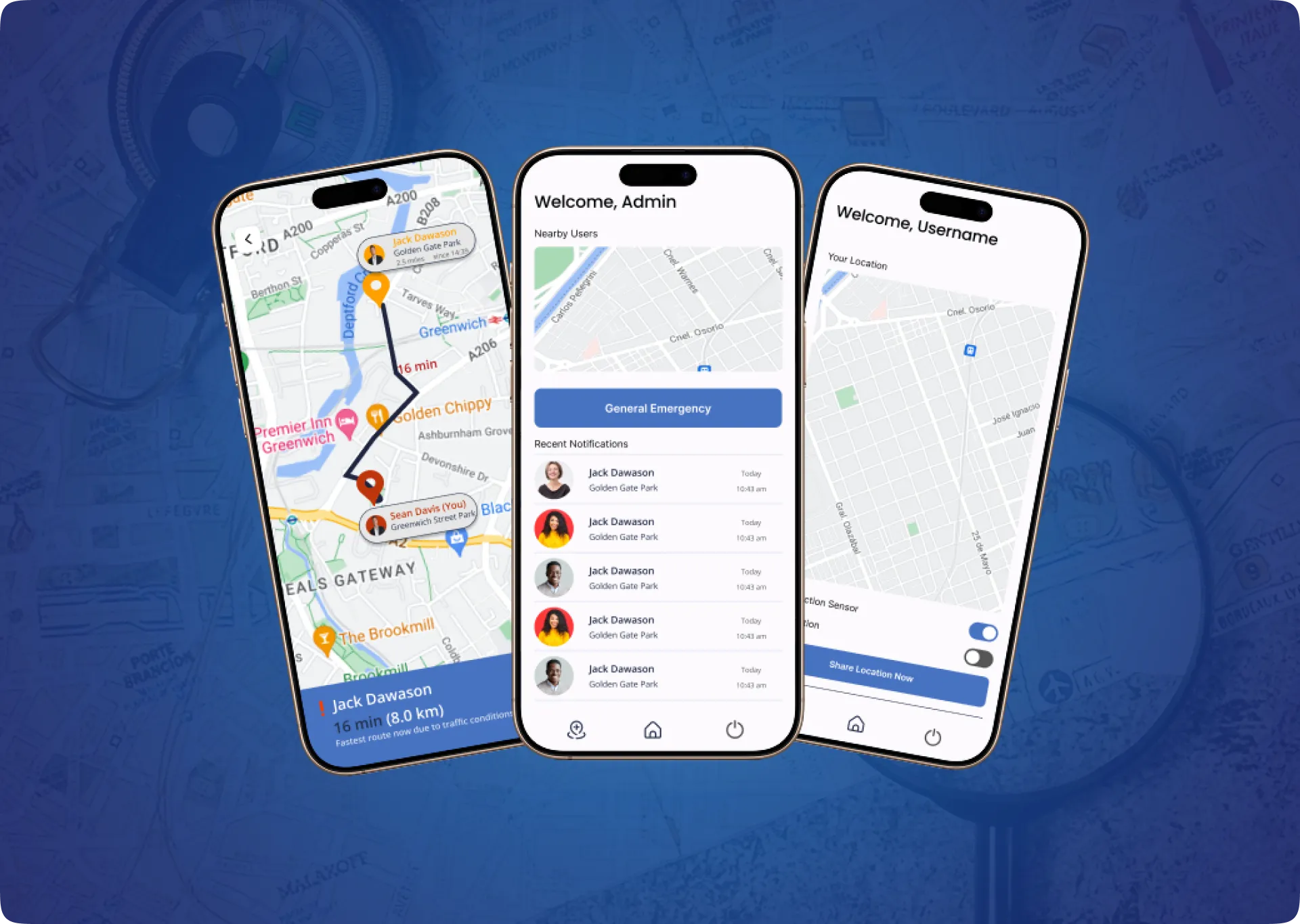
Yes. A machine monitoring platform we built for a US manufacturer has separate real-time views for platform admins, factory admins and machine operators, with role-based access and live updates over SignalR. Managers see utilisation and downtime trends, while operators see their own machines, alerts and downtime reasons on tablets or mobile.
Can AI predict machine failures?
Yes, once enough history exists. We start with anomaly detection on vibration, temperature, current and cycle data, which flags unusual behaviour within weeks, then move to failure prediction as breakdown history builds up. AI also helps classify downtime reasons, optimise energy use and answer plain-language questions such as which machine lost most time this week.
What should a machine monitoring MVP include?
Start with live machine states (running, idle, stopped, offline), downtime logging with reasons, utilisation by shift, email or push alerts, and simple dashboards for managers and operators. OEE, ERP sync, maintenance work orders and predictive analytics come next. A focused MVP gets real numbers in front of managers quickly, which builds the case for a wider rollout.
Can IoT data integrate with our ERP or MES?
Yes. We sync machine status, production counts and downtime with ERP and MES systems through their APIs or middleware, so planning, costing and maintenance use real shop-floor data. Integration can start one-way for reporting and become two-way later, for example pushing work orders to operators' tablets.
Ways to work with us
Engagement options
- Offshore software development
- Hire Flutter developers
- Hire AI engineers
- Hire Python developers
- Hire React developers
- Hire Node.js developers
- Hire mobile app developers
- Hire React Native developers
- Hire Vue.js developers
- Hire Angular developers
- Hire frontend developers
- Hire backend developers
- Hire full-stack developers
- Hire UI/UX designers
- Hire QA engineers
- Hire DevOps engineers
- Hire cloud engineers
- Hire cybersecurity experts
- Hire SEO specialists
- Hire PPC experts
- Hire WordPress developers
- Hire Webflow developers
- Hire social media managers
- Hire content writers
- Hire digital marketers
- Hire game developers
- Staff augmentation
- Project cost calculator
Global delivery
IoT & Smart Manufacturing software for clients worldwide
North America
Middle East
South Asia
Free consultation
Let's build something that actually works
Tell us about your project and get a free 30-minute consultation with a senior engineer. You'll leave with clear next steps, whether you work with us or not.
- Reply within one business day
- NDA on request, 100% IP ownership
- Clear scope, timeline and estimate
- Talk directly to senior engineers